Charlie Allison
April 20, 2025
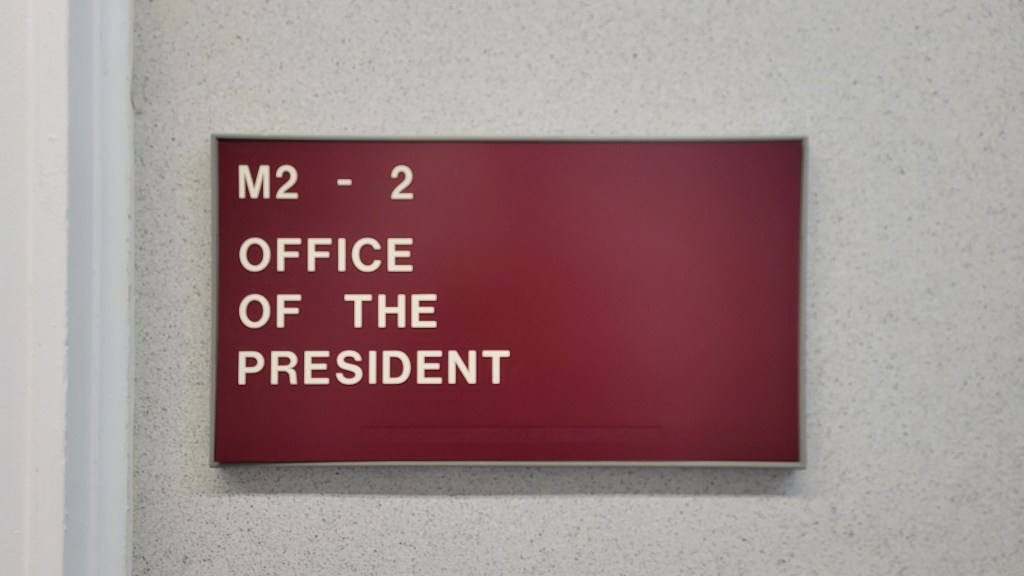
The office of the President of the Community College of Philadelphia is harmful and should be abolished. The latest president was a practical study in everything wrong with the office of the presidency: it’s top-down, arbitrary use of power and money, it’s nominal role (fundraising and self-promotion) a crude joke, and it’s profoundly anti-democratic nature clear. However, in this, Dr. Donald Guy Generals was not exceptional, merely acting as most college presidents do under neoliberal capitalism.
Indeed, nobody could make the office of the presidency at CCP morally or practically justifiable, whatever their intentions and character. The presidency as it stands does not reflect the interests of the students, faculty and staff of the Community College of Philadelphia. It is at best a vehicle for the rich to become richer and at worst an active opponent of the best interests of the students, faculty and staff of the college.
We don’t have a president now and we shouldn’t have one in the future.
In fact, not having a president at CCP might be one of the smartest things we could possibly do collectively to make sure that those most impacted by the decisions the college makes are the ones making those decisions—that is, the students, faculty and staff of the college.
But first, a quick history lesson:
Dr. Generals’ tenure was a showcase of all the president can do to hamstring the college’s stated mission while enriching themselves. For example, the office of the presidency comes with a salary well north of 300k a year, which included a housing and car stipend. Meanwhile, a not insignificant number of students are uncertain of their next meal is coming from, how they will get to campus for classes or where they will sleep safely that night.
Speaking of money, remember last year when Dr. Generals refused to ask City Hall for additional funds to make badly needed operational repairs to the college? He smugly said “We’re quite comfortable with the level of support City Hall has given us. They’ve been very generous.” In short, the president of the college refused to aid his own college and do his self-described job as chief fundraiser for the institution.
The Union and the students, undeterred by the typical display of craven bootlicking demonstrated by the presidency, organized a campaign together. Together we won 5 million dollars from City Hall—a quarter of the 20 million we had asked for but still the largest one year monetary increase in the history of the college. However, Dr. Generals and the board refused to disclose where the five million dollars we won was going to be spent, confirming only that it had been received. The board of trustees is also an obstacle to actual democratic governance of CCP but let us stay on topic here.
The above incident demonstrates two things: that the office of the president (a position inflicted upon the students, faculty and staff by the mayor of the city, like a wizard’s curse or some sort of telemarketing scam) is extremely undemocratic. The president of CCP is a glorified toady, flunky, sycophant, loyalist, Quisling, court favorite etc. of whoever the mayor of Philadelphia happens to be. The president’s interest is in pleasing their boss—the mayor—and staying in the office of the presidency.
This is a deliberate structural flaw in how CCP is run—it is hard to conceive of a system less kindly disposed towards democratic governance. The trouble with the presidency is structural, not personal—no matter how fun it might be to rightly lampoon a man named Dr. Donald Guy Generals. The office of the president is meant to consolidate power in one set of hands, which means taking it away from people who learn and teach at the college.
This brings us rather neatly to our second point—which is the constructive, rather than the destructive case for the abolition of the presidency. The students and workers of the Community College of Philadelphia have shown that they can and do organize to fundraise for the college, raise awareness of the (many) plights of CCP and are perfectly capable of self-governance.
We have very clear recent examples of the power that student faculty and staff can wield—see the 5 million dollar example above, as well as mobilizations around free SEPTA transpasses and childcare on campus (currently ongoing). Students, tired of administration censorship and austerity, created their own newspaper on a shoestring that still is enormously helpful and informative.
The 300k that is thrown away in the presidential salary and perks could be put towards repairing central air conditioning for classrooms that are either boiling or freezing (seemingly at random), updating technology (like the computer lab), maintaining facilities like the bathrooms or helping efforts to resolve student homelessness, hunger and debt—just off the top of my head.
It is the permanent cry of the dead-inside, the apparatchik, sell-out and coward that if only we had the right people in charge of a bad system then the system would function better—but in the case of CCP, the system is functioning as intended—to Hoover money from students upwards to the already rich.
So what should we do, what are the practical steps to be taken?
There is a lot to do. It all starts with building on the victories that the students and workers of CCP have already won and proceeds on as directly as possible along democratic principles.
-The charter of CCP will have to be re-written to cut out the office of the presidency.
-Continue student assemblies, the organization of student- led things without administration’s ‘blessing’ or funds.
-Collaboration between students, faculty and staff—for example, publicly making sure that the administration carries out the terms of the latest contract (i.e. free SEPTA trans-passes, on campus child-care, retro-pay, etc.)
-Actively campaign against the idea of the presidency: all that office has done is hoard money and give us bullshit lion statues.
-When an interim president is appointed (as seems likely), ignoring any and all demands/requests/policies they put forward and denying the legitimacy of their (inflicted) ‘authority’.
-Build dual power—work directly with the student body and the faculty and staff (via the Federationunion) to enact changes that are within our power to win/create without dealing with administrators whenever possible.
-What money we as workers and students win from organizing and fundraising from anywhere—City Hall, the state of Pennsylvania—–we should have the figurative teeth to enforce that it is spent where it is needed: towards the common, material goods for the students, faculty and staff as well as a significantly expanded voice in deciding where the yearly budget money is spent.
Students, faculty and staff can run CCP better than any mayor-appointed albatross of a president ever could.

 The Independent
Leave a reply to Anonymous Cancel reply